

Have you ever come across the word “adjacent” and wondered what it really means? While it’s a common term in English, many people confuse it with words like “nearby” or “next to.”
Understanding the true meaning of adjacent can help you describe locations, objects, and even abstract ideas more accurately. In simple terms, something that is adjacent is directly next to or touching something else, sharing a common boundary or edge.
The word comes from the Latin “adjacere,” which means “to lie near,” reflecting its idea of closeness and connection.
In this article, we will explore the definition of adjacent, provide clear examples in everyday life, explain its use in math, geography, and science, and highlight common mistakes to avoid.
By the end, you’ll not only know what adjacent means, but also how to use it correctly in sentences, maps, diagrams, and more.
1: Definition of Adjacent
The word “adjacent” is often used to describe things that are next to each other or share a common boundary. According to major dictionaries like Merriam-Webster and Oxford, adjacent means “lying near, close, or adjoining”. In other words, when two objects, places, or concepts are adjacent, they are directly beside one another, often with nothing in between. This distinguishes “adjacent” from words like “nearby,” which can suggest closeness but not necessarily touching or direct connection.
The origin of adjacent comes from the Latin word “adjacere,” meaning “to lie near.” This root reflects the core idea of proximity and connection that the word carries in English. Over time, adjacent has become a precise term used not only in everyday conversation but also in academic, scientific, and technical contexts.
For example, you might say, “The kitchen is adjacent to the dining room,” meaning the two rooms are directly next to each other, likely sharing a wall. Similarly, in geography, a city can be adjacent to another city if they share a border. The word also extends into abstract use, such as in math or computer science, where “adjacent” defines exact relationships, like adjacent sides of a polygon or adjacent nodes in a graph.
Understanding this definition is the first step to using adjacent correctly in sentences, diagrams, and real-world contexts. It emphasizes direct closeness or connection, making your communication precise and clear.
2: Adjacent in Everyday Language
In everyday language, the word “adjacent” is used to describe things that are directly next to or beside each other, often sharing a physical boundary. Unlike general terms like “nearby” or “close,” adjacent implies immediate proximity, meaning there is little to no space between the objects. Understanding this distinction can help you communicate more precisely in daily conversations.
For instance, you might say, “The bookstore is adjacent to the coffee shop.” This indicates that the two establishments are side by side, perhaps even sharing a wall, rather than simply being in the same neighborhood. Similarly, in a home setting, “The living room is adjacent to the kitchen” suggests a direct connection or immediate next-door placement, which is more specific than just saying the rooms are close to each other.
The word adjacent can also describe non-physical relationships in daily life. For example, in a schedule, two events can be adjacent if they happen one immediately after the other. While this use is less common than physical adjacency, it demonstrates the word’s flexibility.
It’s important to avoid confusing adjacent with similar terms. Words like “nearby” or “next-door” do not always convey the same sense of direct contact. By using adjacent correctly, you make your descriptions more accurate, whether you are talking about rooms, buildings, streets, or even items on a desk.
Using adjacent in everyday language helps clarify exact placement and relationships, making your communication clear and precise.
3: Adjacent in Mathematics
In mathematics, the word “adjacent” is used with precision to describe objects that are next to each other or share a common point, side, or vertex. Understanding adjacency in math is crucial because it defines exact relationships between shapes, angles, and elements in diagrams.
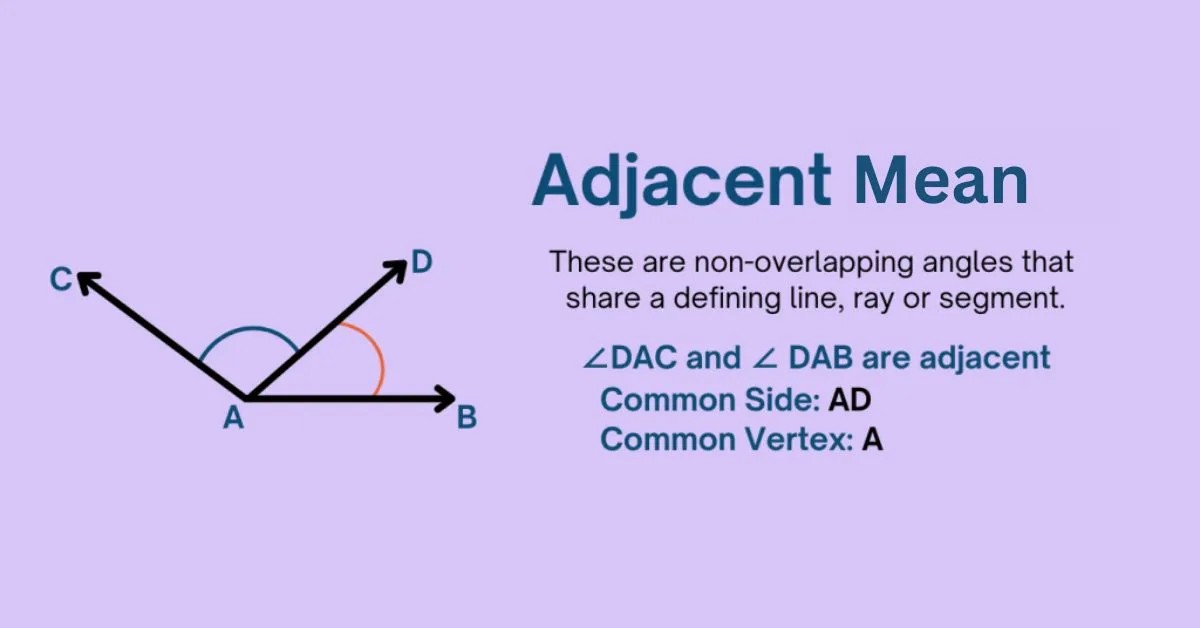
One common example is adjacent angles. These are two angles that share a common vertex and a common side, but do not overlap. For instance, in a pair of angles formed by two intersecting lines, each angle next to the other is considered adjacent. This concept is important in geometry when solving problems involving angle sums or linear pairs.
Another example is adjacent sides of polygons. In a square or rectangle, any two sides that meet at a corner are adjacent, while sides across from each other are opposite. Similarly, in triangles, each side is adjacent to the two sides that meet at its endpoints.
The term also applies to adjacent vertices, which are points where sides meet in a polygon. Two vertices connected by a single side are considered adjacent vertices.
Using adjacent in math is more precise than simply saying “next to.” It ensures that relationships between elements are clearly defined, avoiding confusion in calculations, proofs, or diagrams. Visual representations, such as labeling sides or angles, can make adjacency easier to understand.
In short, whether describing angles, sides, or vertices, adjacent in mathematics emphasizes exact positioning and connection, helping students and professionals communicate with clarity and accuracy.
:
4: Adjacent in Geography, Urban Planning, and Science
The word “adjacent” is commonly used in geography, urban planning, and scientific contexts to describe locations, regions, or objects that are directly next to each other or share a boundary. Understanding this usage can help explain spatial relationships clearly and accurately.
In geography, two countries, cities, or regions are considered adjacent if they share a border. For example, France and Germany are adjacent countries because they have a shared boundary. Similarly, neighborhoods in a city can be adjacent if they are side by side, which is useful when describing urban layouts or planning infrastructure. Maps often use adjacency to show proximity and relationships between different areas.
Urban planners also use the term adjacent when designing buildings, streets, or public spaces. For instance, a park might be described as adjacent to a school if it is located immediately next to it, helping planners, architects, and residents understand the spatial arrangement of the environment.
In science, adjacent can describe cells, structures, or time intervals that are next to each other. For example, in biology, two adjacent cells share a border, while in physics or scheduling, adjacent time slots occur one right after the other.
Using adjacent in these contexts emphasizes direct connection and closeness, which makes descriptions precise. Whether you are reading a map, designing a building, or studying scientific patterns, understanding adjacency helps communicate spatial and sequential relationships clearly.
5: Common Mistakes and Misconceptions
While “adjacent” is a straightforward word, many people misuse it, often confusing it with “nearby,” “next-door,” or “beside.” Understanding the differences is essential to using the word accurately in writing and speech.
A common mistake is using adjacent when objects are close but not directly next to each other. For example, saying “The coffee shop is adjacent to the park across the street” is incorrect if there’s a road separating them. In this case, “nearby” would be the correct choice, while adjacent should indicate immediate proximity or direct connection.
Another frequent error is confusing adjacent with “next-door.” While both suggest closeness, next-door is informal and usually applies only to buildings or houses, whereas adjacent can describe rooms, buildings, streets, countries, angles, or abstract items like time intervals. For example, “The library is adjacent to the cafeteria” is more precise than “next door,” which could imply a casual residential context.
People also misuse adjacent in abstract contexts. For instance, two events in a schedule may seem “nearby” in time but are only adjacent if they occur immediately one after the other.
To avoid these mistakes, remember: adjacent always implies direct contact, connection, or immediate succession. If there is even a small gap or buffer, the correct term is “nearby” or “close to.” Using adjacent correctly ensures clarity and precision, whether describing physical spaces, math diagrams, maps, or sequences of events.
6: Fun Facts and Linguistic Insights
The word “adjacent” has more than just practical uses it also has interesting linguistic and historical aspects that make it unique. As mentioned earlier, adjacent comes from the Latin “adjacere,” meaning “to lie near.” This origin emphasizes the idea of closeness and direct connection, which has carried through to modern English.
One fun fact is that adjacent is more formal than everyday words like “next to” or “beside.” Writers, educators, and professionals often prefer it because it conveys precision, especially in technical fields like mathematics, geography, and science. For example, saying “the adjacent angles of a triangle” is far more exact than “the angles next to each other.”
Interestingly, adjacent is also used in abstract or specialized contexts. In computer science, for instance, adjacent nodes in a network graph are directly connected by an edge, showing a relationship that mirrors physical adjacency in a spatial sense. Similarly, in biology, adjacent cells share a boundary, reinforcing the concept of immediate connection.
Another linguistic insight is that adjacent has several synonyms, including adjoining, contiguous, neighboring, and abutting. However, none of these synonyms perfectly captures the versatility of adjacent across different contexts, from everyday usage to technical applications.
Finally, noticing the use of adjacent in books, articles, or maps can sharpen your awareness of precise language. The word not only improves vocabulary but also enhances clarity when describing relationships, proximity, or sequences in almost any context.
7: Examples and Practice Sentences
One of the best ways to fully understand “adjacent” is through examples and practice sentences. Seeing the word in context makes it easier to use correctly in everyday speech, writing, or academic work.
Everyday Examples:
- “The kitchen is adjacent to the dining room.” The two rooms are directly next to each other.
- “The bookstore is adjacent to the coffee shop.” Indicates that the two establishments share a side or wall.
- “My office is adjacent to the conference room.” Highlights immediate proximity in a workplace.
Mathematics Examples:
- “In this triangle, sides AB and AC are adjacent sides.” They meet at a common vertex.
- “Angle A and angle B are adjacent angles because they share a vertex and a side.” Demonstrates precise geometric relationships.
Geography and Places:
- “Canada is adjacent to the United States.” The countries share a border.
- “The new park is adjacent to the library.” Useful for urban planning or describing locations.
Abstract or Time-Based Examples:
- “The two meetings are adjacent on the schedule.” They occur immediately one after the other.
- “In the data set, adjacent numbers represent consecutive values.” Shows how adjacency can apply in technical contexts.
Practice Tip: To master adjacent, try creating sentences using objects, rooms, streets, or even abstract sequences. Ask yourself: “Do these things touch, connect, or come immediately after each other?” If yes, adjacent is the right word. This simple habit will improve your precision in writing and speaking
Frequently Asked Questions (FAQs)
1. Is “adjacent” the same as “next to”?
Not exactly. While both words indicate closeness, adjacent emphasizes direct contact or immediate connection, whereas “next to” can be less precise. For example, “The library is adjacent to the cafeteria” suggests a shared wall or immediate side-by-side placement, while “next to” could be interpreted more casually.
2. Can “adjacent” be used for time?
Yes. Adjacent can describe events, intervals, or sequences that occur immediately one after the other. For instance, “The two meetings are adjacent on the schedule” means there is no gap between them. This abstract use is common in scheduling, data analysis, and technical fields.
3. Can “adjacent” refer to abstract concepts, or only physical objects?
Adjacent is versatile. It can describe physical objects (rooms, buildings, countries), mathematical elements (angles, sides, vertices), or abstract sequences (time intervals, data points, nodes in a network). The key is that adjacency implies immediate proximity or connection, whether physical or conceptual.
4. What are common mistakes to avoid?
- Using adjacent when objects are close but not touching—use “nearby” instead.
- Confusing adjacent with next-door, which is informal and limited to residential buildings.
- Overlooking adjacency in abstract contexts, like time or graphs.
By understanding these FAQs, readers can confidently use adjacent in both everyday and technical contexts, ensuring precision, clarity, and correct usage.
Conclusion
Understanding the meaning and proper use of “adjacent” can greatly improve your clarity and precision in communication.
Whether you are describing physical spaces, mathematical concepts, geographical regions, or even sequences in time, adjacent conveys direct proximity, connection, or immediate succession.
This makes it a versatile and powerful word in both everyday language and technical contexts.
In everyday life, adjacent helps describe rooms, buildings, streets, or objects that are directly next to each other.
For example, saying “The kitchen is adjacent to the dining room” communicates exact placement more clearly than just saying the rooms are “near” each other.
In academic and professional contexts, such as mathematics or geography, adjacent provides precise definitions for angles, sides, vertices, countries, or neighborhoods, ensuring accuracy and avoiding confusion.
Additionally, adjacent extends to abstract situations, such as consecutive events, time intervals, or connected elements in data or networks.
Using the word correctly in these contexts demonstrates not only vocabulary knowledge but also attention to detail.
By learning the differences between adjacent and similar words like “nearby” or “next-door,” avoiding common mistakes, and practicing with examples, you can confidently apply adjacent in a wide variety of situations.
Paying attention to adjacency in both physical and abstract settings will make your writing and speech clearer, more precise, and professional.
In summary, mastering adjacent allows you to describe relationships, connections, and proximity with accuracy, whether in everyday life, math, geography, or technical fields.
It’s a small word with a big impact on clarity and understanding.

Margaret Johnson was an American blues and early jazz vocalist and pianist active during the 1920s. She began her recording career in the early part of that decade, performing in vaudeville and jazz ensembles, and is best remembered for her work in blues music.