

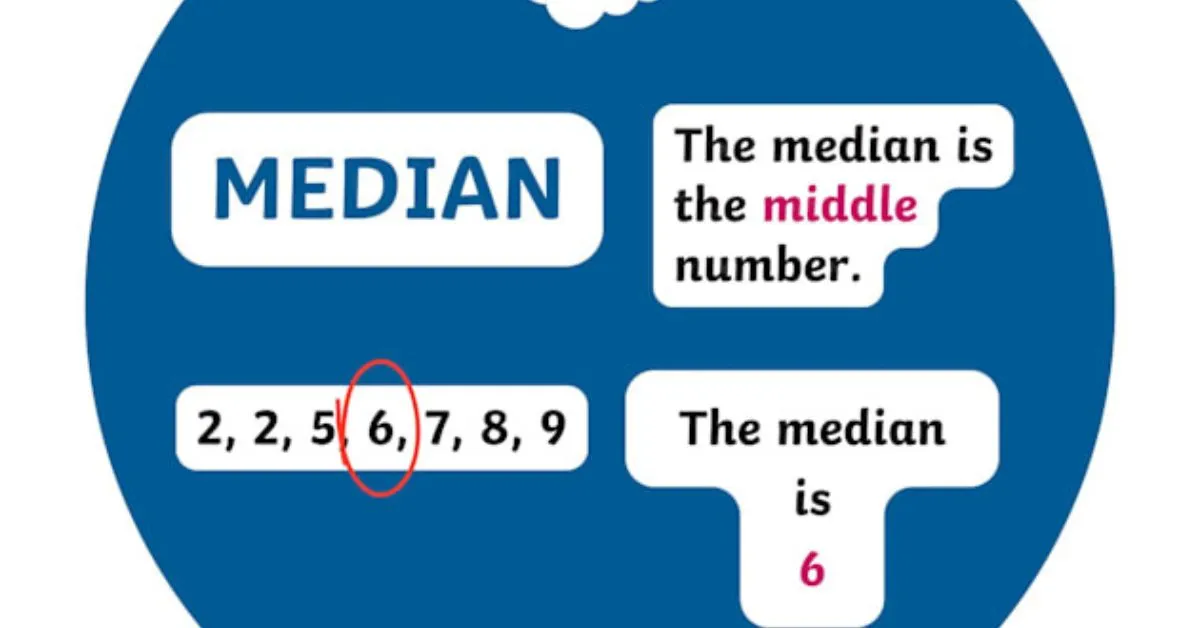
If you’ve ever looked at a set of numbers and wondered what the “middle” really represents, you’ve already brushed up against the idea of the median.
The term median is commonly used in mathematics and statistics, but it also appears in everyday situations such as discussing test scores, household income, or property prices.
Understanding what median means helps you make better sense of data and avoid misleading conclusions that can come from simple averages.
In basic terms, the median shows the central value in a group of numbers once they are arranged in order.
Unlike the mean (average), the median is not heavily affected by extremely high or low values. This makes it especially useful when analyzing uneven or skewed data.
In this article, you’ll learn what the median means, how to calculate it step by step, see clear examples, and understand why it is such an important measure in both academics and real life.
What Does Median Mean? (Core Definition)
The median is one of the key measures of central tendency in mathematics and statistics. It provides a clear picture of the “center” of the data, giving insight into what a typical value might be. Unlike the mean, which averages all numbers, the median focuses only on the central position, making it less influenced by extremely high or low values also known as outliers.
For example, consider the set of numbers: 2, 4, 7, 10, 15. Since there are five numbers, the middle one 7 is the median. Now, if the highest number were 100 instead of 15, the mean would rise significantly, but the median would remain 7, showing its resilience to extreme values. This property makes the median particularly useful in real-life situations such as income analysis, property prices, or test scores, where extreme data points can distort the average.
Mathematically, the median is simple to define but powerful in application. It is widely used in statistics, research, economics, and education. By identifying the central value of a dataset, it helps summarize large amounts of information in a single, understandable figure. Throughout this article, we will break down how to calculate the median, provide examples, compare it with other measures like mean and mode, and explain why the median is often a better indicator of typical values than the simple average.
How to Find the Median (Step-by-Step Guide)
Finding the median is a straightforward process, but it requires careful attention to the order of the data. The first step is always to arrange the numbers in ascending or descending order, from the smallest to the largest or vice versa. This step is crucial because the median depends entirely on the position of values within the dataset. Without ordering, the “middle” value cannot be correctly identified.
Once the numbers are in order, the method differs slightly depending on whether the dataset has an odd or even number of values.
1. Median for an Odd Number of Values:
If there is an odd number of numbers in the dataset, the median is simply the middle number. For example, in the dataset 3, 5, 7, 9, 11, there are five numbers. The third number, 7, is the median because it is exactly in the center.
2. Median for an Even Number of Values:
If there is an even number of numbers, there is no single middle value. In this case, the median is the average of the two middle numbers. For example, in the dataset 2, 4, 6, 8, there are four numbers. The middle numbers are 4 and 6. The median is calculated as (4 + 6) ÷ 2 = 5.
This step-by-step approach ensures that the median accurately reflects the central tendency of the dataset. By following these rules, you can find the median for any list of numbers, whether it is small and simple or large and complex. Later sections will show real-life examples and explain why the median often gives a better sense of a “typical value” than the mean in uneven datasets.
Median with Real-Life Examples
Understanding the median becomes much clearer when we look at real-life examples. Unlike the mean, the median provides a more accurate picture of what is “typical” in a dataset, especially when there are extreme values or outliers.
Example 1: Household Income
Imagine five households with annual incomes of $25,000, $30,000, $35,000, $40,000, and $500,000. Calculating the mean would give a misleadingly high average because of the one extremely wealthy household. However, the median income is $35,000 the middle value when the incomes are ordered. This shows the typical earning more realistically.
Example 2: Test Scores
Consider students’ test scores: 55, 60, 65, 70, and 100. The mean score is 70, which is pulled up by the one very high score. The median score is 65, reflecting what most students actually scored.
Example 3: Age of Participants
In a group of people aged 18, 20, 22, 23, 45, the median age is 22.
These examples highlight why median is particularly useful in economics, education, health statistics, and social research. Whenever datasets contain extreme values, median helps summarize the information in a way that is more representative of the typical experience.
By using median in real-life scenarios, you can avoid misleading interpretations that averages might suggest, and communicate data in a way that is both accurate and easy to understand. Later sections will compare median with mean and mode to show when each measure is most appropriate.
Median vs Mean vs Mode
In statistics, the median, mean, and mode are all measures of central tendency, but each tells a different story about a dataset. Understanding their differences is crucial for interpreting data accurately.
For example, in the dataset 2, 4, 6, 100, the mean is (2 + 4 + 6 + 100) ÷ 4 = 28, which does not reflect the typical values.
Median (Middle Value): The median is the central value in an ordered dataset. In the same dataset, the numbers arranged in order are 2, 4, 6, 100. With four numbers, the median is the average of the two middle values: (4 + 6) ÷ 2 = 5. This better represents the “typical” value because it is not skewed by the outlier 100.
Mode (Most Frequent Value): The mode is the number that appears most frequently. For example, in the dataset 2, 2, 4, 6, 100, the mode is 2, since it occurs twice. Mode is useful for categorical data or identifying common occurrences but may not reflect the overall distribution.
| Measure | Calculation | Example | Best Use Case |
| Mean | Sum ÷ Count | 28 | Evenly distributed data |
| Median | Middle value | 5 | Skewed data, outliers present |
| Mode | Most frequent | 2 | Categorical data or most common value |
In summary, median is often preferred when datasets have extreme values, mean is suitable for balanced data, and mode highlights the most common occurrences. Choosing the right measure ensures accurate interpretation of the data.
Why Is Median Important?
The median is an essential measure in statistics and everyday life because it provides a clear picture of the “middle” value in a dataset, which often reflects what is typical or representative. Unlike the mean, the median is resistant to extreme values, making it a more reliable measure when datasets include outliers. This property is particularly important in fields like economics, education, and healthcare, where skewed data is common.
For example, in income analysis, a few very high earners can dramatically raise the average income, giving a misleading impression of what most people earn. The median income, however, shows the midpoint of all incomes, representing the value that divides the population in half. Similarly, in education, median test scores give a better understanding of how most students perform, especially if a few unusually high or low scores would distort the mean.
Beyond real-life applications, median is critical in statistical research. Researchers often use median values to summarize large datasets, compare groups, and analyze trends.
In addition, the median provides a simple, intuitive understanding of data for audiences without a statistical background. By showing the central tendency without being affected by extreme values, it ensures fair and accurate representation, making data-driven decisions more meaningful and reliable.
In short, the median is not just a mathematical concept it is a practical tool that helps interpret, communicate, and understand data more effectively.
Median in Different Fields
The concept of median extends far beyond math classrooms and is widely used in many fields to summarize data accurately. Its ability to represent the “middle value” makes it particularly valuable when datasets include extreme or skewed numbers.
1. Mathematics and Education:
In schools and colleges, median is taught as part of statistics to help students understand central tendency. Teachers often ask students to calculate the median of test scores or number sets, reinforcing the idea of the middle value. It also introduces students to the importance of ordering data and recognizing outliers.
2. Economics and Finance:
Economists frequently use median to analyze income, wages, and wealth distribution.
3. Health and Social Research:
In healthcare, median values can summarize data such as patient recovery times, blood pressure readings, or age at diagnosis. Researchers often use the median when reporting survey results or clinical trial outcomes, especially when extreme values could distort averages.
4. Data Analysis and Business:
Companies use the median to understand customer behavior, product pricing, and performance metrics. For example, median sales or median customer spend gives a realistic view of typical behavior rather than an inflated or deflated average.
Across all these fields, the median provides a clear, reliable, and fair representation of data, making it a crucial tool for interpretation, decision-making, and communication. Its versatility and resistance to skewed data make it indispensable in both theoretical and applied contexts.
Median in Graphs and Data Visualization
The median is not only a numerical concept but also an important element in data visualization.
One common way to show the median is on a number line. By arranging all data points along a line and marking the middle value, viewers can immediately see where the central point lies. This method is particularly useful for small datasets, allowing a simple, intuitive understanding of the median.
Another widely used tool is the box-and-whisker plot (or box plot).
Histograms and bar charts can also indicate the median, though less directly. Some charts highlight the median line to compare groups or track trends over time. For example, median household income or median test scores can be represented with a horizontal line across a chart, giving immediate insight into typical values.
By visualizing the median, data analysts, researchers, and educators can communicate complex datasets clearly and effectively. A well-placed median line simplifies interpretation, shows trends, and highlights the central value without the distortion caused by outliers.
Common Mistakes and Misconceptions About Median
Although the median is a simple and powerful concept, people often make mistakes or misunderstand how it works. Being aware of these common errors can help ensure accurate calculations and interpretations.
1. Forgetting to Order the Data:
The most frequent mistake is calculating the median without arranging the numbers in order. Since the median is the middle value of an ordered dataset, failing to sort the numbers can lead to an entirely incorrect result. Always arrange values from smallest to largest (or vice versa) before identifying the median.
2. Confusing Median with Mean:
Many people assume the median and the mean are the same. Unlike the mean, which is the average of all numbers, the median focuses only on the middle position. In datasets with extreme values or outliers, the mean can be misleading, while the median gives a more representative central value.
3. Assuming Median Must Be in the Dataset:
In datasets with an even number of values, the median may not be a number present in the dataset. For example, in 2, 4, 6, 8, the median is (4 + 6) ÷ 2 = 5, which is not one of the original numbers. Misunderstanding this can cause unnecessary confusion.
4. Misinterpreting Median in Skewed Data:
Some assume the median alone fully describes the dataset. While it shows the central value, it does not indicate how spread out the data is. It’s important to consider median alongside other measures like the mean, mode, and range.
5. Ignoring Context:
Using the median without context can also be misleading. For example, reporting the median income without noting the income range or number of participants may not tell the full story.
By avoiding these mistakes, you can ensure that the median is accurate, meaningful, and useful in both calculations and real-life applications.
Advantages and Limitations of Median
The median is a widely used statistical measure because it effectively represents the central value of a dataset, but like any tool, it has both advantages and limitations. Understanding these helps determine when the median is the best choice for analysis.
Advantages:
- Resistant to Outliers: The median is not affected by extremely high or low values. For example, in a dataset of incomes $25,000, $30,000, $35,000, $40,000, $500,000 the median is $35,000, which better reflects the typical income than the mean of $126,000.
- Simple to Understand: It is easy to explain and visualize, making it accessible to students, professionals, and general readers alike.
- Useful for Skewed Data: When data is not evenly distributed, the median gives a more accurate picture of the “middle” than the mean. This is particularly helpful in areas such as real estate, economics, and social research.
- Clear Interpretation: It directly identifies the middle value, which is intuitive and meaningful in most contexts.
Limitations:
- Ignores Data Spread: The median does not account for how values are distributed across the dataset. Two datasets with the same median may have very different ranges or variations.
- Not Always a Dataset Value: In even-numbered datasets, the median may be a number that doesn’t exist in the dataset, which can confuse some readers.
- Limited Use in Calculations: Unlike the mean, the median cannot be easily used in algebraic calculations or statistical formulas like variance or standard deviation.
In conclusion, the median is ideal for understanding central tendency in skewed or uneven data, but it is best used alongside other measures like the mean and mode to get a complete picture of the dataset.
Frequently Asked Questions (FAQs) About Median
The concept of median often raises questions, especially for students or anyone new to statistics. Addressing common queries can clarify confusion and make it easier to apply in real-life scenarios.
1. What does median mean in simple terms?
The median is the middle value in a set of numbers once they are arranged in order. It represents the “central” point of the data, giving an idea of what is typical or average without being affected by extreme values.
2. Can the median be a decimal?
Yes. When a dataset has an even number of values, the median is calculated as the average of the two middle numbers. This means the median may not be a number that actually appears in the dataset. For example, in 4, 6, 8, 10, the median is (6 + 8) ÷ 2 = 7.
3. Is the median always one of the numbers in the dataset?
Not always. As mentioned, for even-numbered datasets, the median can be a value between two numbers. For odd-numbered datasets, the median is one of the original numbers.
4. Why is median used instead of mean?
Median is preferred when datasets contain outliers or extreme values that would distort the mean. For instance, median household income is more representative than mean income because a few extremely high incomes can inflate the average.
5. Can there be more than one median?
No. The median is always a single value that divides the dataset into two equal halves, even if it is calculated as an average of two numbers.
These FAQs highlight why understanding the median is important. It is a simple yet powerful tool for summarizing data and making sense of numerical information in both academics and real-life applications.
Summary and Key Takeaways
Unlike the mean, which averages all values, the median provides a more accurate reflection of a typical value, especially when datasets contain extreme values or outliers.
This makes it an essential tool for analyzing skewed data, whether in academics, research, economics, or everyday life.
Calculating the median depends on whether the dataset has an odd or even number of values.
For an odd number, the median is the middle value. For an even number, it is the average of the two middle numbers.
This simple method allows anyone to quickly identify the central tendency of a set of numbers and interpret data accurately.
The median is widely applied in real-life scenarios. Examples include household income, test scores, property prices, patient recovery times, and survey results.
Its resilience to outliers ensures that extreme values do not distort the representation of typical data.
While the median has clear advantages such as simplicity, reliability, and resistance to outliers it also has limitations.
It does not account for the spread of data and cannot be directly used in complex mathematical calculations like the mean.
Therefore, it is best used alongside other measures, such as mean and mode, for a comprehensive understanding of datasets.
In summary, the median is a powerful, practical, and easy-to-understand measure that provides meaningful insights across academics, research, and real-life applications, helping individuals and organizations interpret data with clarity and confidence.

Rafael Domínguez Gamas (born February 14, 1883 in Cárdenas, Tabasco; died January 23, 1959 in Veracruz) was a prominent Mexican lawyer, educator, journalist, writer, and academic. He studied law at the Instituto Juárez and also worked as a professor there. Early in his career he directed schools in various towns in Tabasco and contributed frequently to publications such as Alba, El Renacimiento, and El Eco de Tabasco. In 1914 he moved to Veracruz, where he worked with the journal El Dictamen. He was later elected a corresponding member of the Academia Mexicana de la Lengua for his contributions to Mexican literature and language studies. Domínguez authored numerous books and essays including Azul como tus ojos (1925) and Diccionario general de gentilicios (1948).