

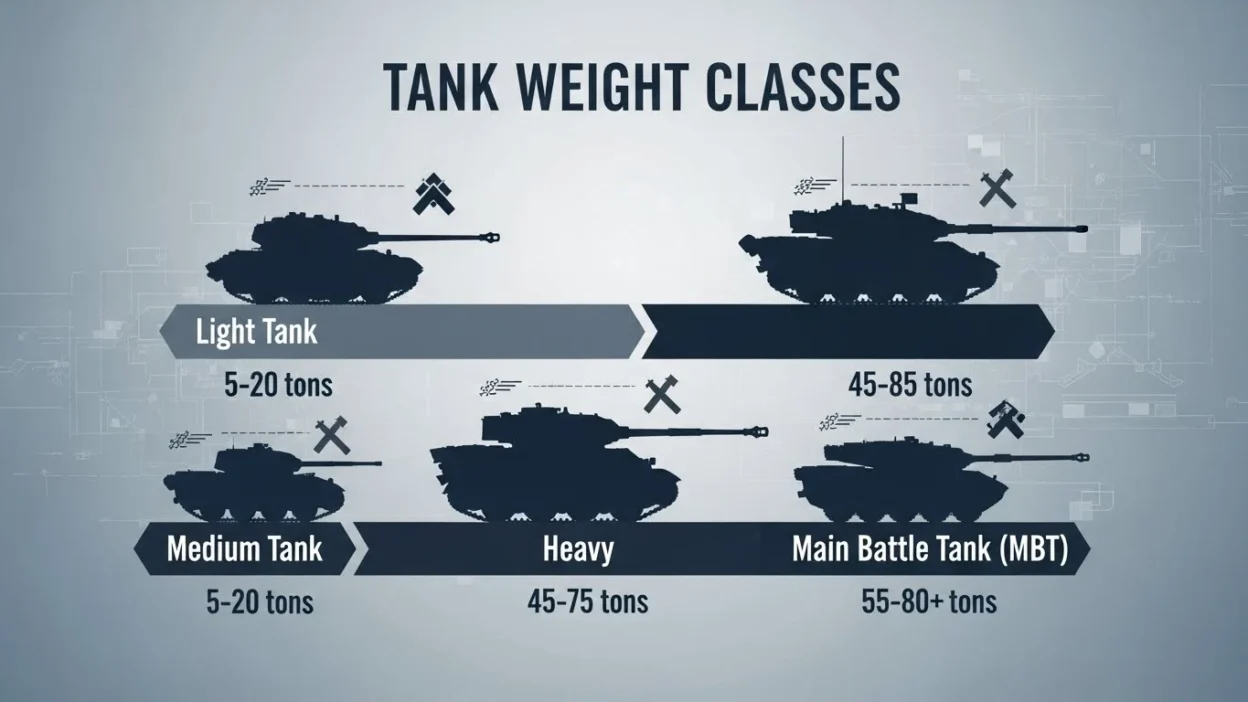
Tank weight class is one of the most important factors in armored vehicle design, directly influencing a tank’s mobility, protection, firepower, and overall battlefield effectiveness.
From the earliest armored vehicles of World War I to today’s advanced main battle tanks, military engineers have continuously balanced weight against performance and survivability.
Heavier tanks generally provide stronger armor and more powerful weapons, while lighter tanks offer greater speed, flexibility, and ease of deployment. Because of this trade-off, tanks have traditionally been classified into different weight categories, each designed for specific combat roles and strategic requirements.
Understanding tank weight classification helps explain why armies field multiple types of armored vehicles and how terrain, logistics, and modern threats shape tank development.
As warfare evolves and new technologies emerge, the importance of weight remains central to tank design decisions, making tank weight class a key concept in modern armored warfare analysis.
Evolution of Tank Weight Classes
The evolution of tank weight classes is closely tied to advances in military technology, industrial capacity, and battlefield requirements. During World War I, the first tanks were extremely heavy for their time, designed primarily to cross trenches and withstand small-arms fire. Limited engine power and basic suspension systems restricted mobility, forcing early designers to accept slow speeds in exchange for protection. At this stage, weight classification was informal and largely experimental.
In the interwar period, improvements in engines, armor manufacturing, and weapon systems allowed engineers to explore more specialized designs. Tanks began to diverge into lighter models intended for reconnaissance and rapid maneuvers, and heavier models built for direct combat and breakthrough operations. By World War II, tank weight classes had become clearly defined, with light, medium, and heavy tanks each fulfilling distinct battlefield roles. Medium tanks emerged as the most versatile option, balancing mobility and firepower, while heavy tanks focused on superior armor and large-caliber guns at the cost of speed and logistical efficiency.
The Cold War marked a major shift in tank design philosophy. Advances in armor technology and the increasing threat of anti-tank weapons led to the gradual disappearance of traditional heavy tanks. In their place, the main battle tank concept emerged, combining the firepower of heavy tanks with the mobility of medium tanks. Modern tanks continue to grow heavier due to advanced protection systems and electronics, but their classification reflects evolving doctrines rather than simple weight alone.
Light Tanks
Light tanks represent the lowest weight class in armored vehicle classification and are designed primarily for speed, mobility, and operational flexibility. Typically weighing significantly less than medium or main battle tanks, light tanks sacrifice heavy armor in favor of rapid movement and ease of deployment. Historically, their primary role has been reconnaissance, screening, and support for larger armored formations rather than direct engagement with heavily armored enemy vehicles.
During World War II, light tanks were widely used for scouting missions, infantry support, and exploitation of breakthroughs. Their lighter weight allowed them to traverse bridges, soft terrain, and narrow roads that heavier tanks could not safely use. However, as anti-tank weapons became more powerful, the limited protection of light tanks made them increasingly vulnerable on the modern battlefield. This led many armies to reduce their use in frontline combat roles during the late 20th century.
In recent years, light tanks have experienced renewed interest due to changing warfare environments. Modern conflicts often involve urban terrain, rapid-response operations, and expeditionary missions where heavy tanks are difficult to deploy. Advances in armor materials, active protection systems, and precision weaponry have improved the survivability of modern light tanks without dramatically increasing weight. Today, they are often used for rapid deployment forces, border security, and operations in regions with limited infrastructure, proving that lighter weight classes still hold strategic value in contemporary armored warfare.
Medium Tanks
Medium tanks were historically designed to provide a balance between mobility, firepower, and protection, placing them at the center of armored warfare throughout much of the 20th century. Falling between light and heavy tanks in weight, medium tanks were capable of engaging enemy armor while still maintaining enough speed and endurance to operate across diverse terrain. This balance made them the backbone of many armored forces during World War II.
In combat, medium tanks were expected to perform a wide range of roles, including frontline engagements, infantry support, and exploitation of enemy breakthroughs. Their moderate weight allowed for easier transportation and lower logistical demands compared to heavy tanks, while still carrying guns powerful enough to defeat most opposing vehicles of their era. As a result, medium tanks offered commanders greater operational flexibility and could be deployed in larger numbers.
As armor and weapon technologies advanced, the distinction between medium and heavy tanks began to blur. Heavier armor and larger-caliber guns were gradually incorporated into medium tank designs, increasing their overall weight. By the early Cold War period, this evolution led to the development of the main battle tank concept, which effectively absorbed the role of the medium tank. While traditional medium tanks no longer exist as a separate class, their design philosophy lives on in modern main battle tanks.
Heavy Tanks
Heavy tanks were developed to dominate the battlefield through superior armor protection and overwhelming firepower. Characterized by their substantial weight, these tanks were designed to withstand enemy fire and break through fortified positions that lighter vehicles could not effectively engage. Their thick armor and large-caliber guns made them particularly effective in head-on combat against enemy armored units.
During World War II, heavy tanks played a specialized but influential role. They were often deployed to lead assaults, counter enemy breakthroughs, or engage opposing heavy armor at long range. While their battlefield presence could be decisive, heavy tanks also suffered from significant limitations. Their weight reduced speed and maneuverability, making them less effective in rapid operations. Additionally, heavy tanks placed immense strain on logistics, requiring more fuel, maintenance, and specialized transport equipment.
As anti-tank weapons became more advanced and mobile, the advantages of extremely heavy armor began to diminish. Improved gun technology allowed lighter vehicles to defeat heavy tanks, while advances in armor design enabled better protection without extreme increases in weight. These developments reduced the strategic value of traditional heavy tanks, especially in conflicts requiring rapid deployment and flexibility.
By the Cold War era, most military doctrines moved away from heavy tanks in favor of more balanced designs. The heavy tank concept was eventually absorbed into the main battle tank, which combined strong armor and firepower with improved mobility. Despite their decline, heavy tanks remain an important chapter in armored warfare history, representing the peak of weight-based battlefield dominance.
Super Heavy Tanks
Super-heavy tanks represent the extreme end of armored vehicle weight classifications, often exceeding 70–100 tons. These vehicles were conceived with the idea of creating near-impenetrable battlefield giants capable of crushing fortifications, dominating open terrain, and intimidating enemy forces. Unlike conventional heavy tanks, super-heavy tanks were rarely produced in large numbers due to the enormous engineering, logistical, and operational challenges they presented.
During World War II, several nations experimented with super-heavy tank designs. Germany developed prototypes like the Panzer VIII Maus, which weighed over 180 tons, while the Soviet Union explored multi-turreted behemoths such as the T-35. While these tanks showcased remarkable firepower and armor, they were plagued by serious limitations. Their immense weight restricted mobility, often making them unable to cross standard bridges or navigate soft terrain. They were also slow, mechanically complex, and extremely resource-intensive, limiting their strategic utility.
The logistical burden of transporting, fueling, and maintaining super-heavy tanks made them impractical for most military operations. Advances in anti-tank weaponry further reduced their battlefield effectiveness, as even lightly armored vehicles could threaten these slow-moving giants. Consequently, super-heavy tanks never evolved beyond experimental prototypes, and most projects were abandoned after testing.
Despite their failure as practical weapons, super-heavy tanks played an important role in military engineering and design studies. They pushed the boundaries of armor, engine power, and structural design, influencing later heavy tank and main battle tank developments. Today, they are primarily remembered as ambitious engineering marvels and symbols of the extreme possibilities in armored warfare.
Main Battle Tanks (MBTs)
Main Battle Tanks (MBTs) are the culmination of decades of tank evolution, combining the firepower of heavy tanks with the mobility of medium tanks. Emerging during the Cold War, MBTs were designed to replace multiple traditional weight classes, offering armies a single versatile platform capable of performing a wide range of battlefield roles. Today, MBTs form the backbone of most modern armored forces around the world.
MBTs typically weigh between 50 and 70 tons, though weight can vary depending on armor upgrades, weapon systems, and additional electronics. They are equipped with powerful main guns, advanced targeting systems, and composite or reactive armor, allowing them to engage both enemy tanks and fortified positions effectively. Unlike older heavy tanks, MBTs maintain a balance between protection, firepower, and mobility, enabling them to operate across diverse terrains, from deserts to urban environments.
One of the key advantages of MBTs is their adaptability. Modern designs allow for modular armor upgrades, improved engines, and advanced defensive systems without completely redesigning the platform. This adaptability extends their operational lifespan and ensures relevance against evolving threats, including anti-tank guided missiles and improvised explosive devices.
The MBT concept also simplifies logistics and training for armored units. By consolidating roles that previously required separate light, medium, and heavy tanks, militaries can focus on a single, highly capable platform. As a result, MBTs continue to dominate conventional ground warfare, representing the strategic balance of firepower, survivability, and mobility in modern armored warfare.
Technical Factors Influencing Tank Weight
Tank weight is determined by a combination of design choices, battlefield requirements, and technological limitations. Several technical factors directly influence the overall weight of a tank, shaping its performance, protection, and operational effectiveness.
Armor is the most significant contributor to tank weight. Early tanks relied on simple steel plating, while modern vehicles use composite, ceramic, or reactive armor to provide higher protection without excessively increasing mass. Advances in armor technology allow designers to optimize weight while maintaining survivability, but heavily armored tanks inevitably weigh more.
Armament and ammunition also impact weight. Larger-caliber main guns, additional secondary weapons, and onboard ammunition storage increase mass, while autoloading systems and turret designs add mechanical complexity. Balancing firepower with mobility is a constant engineering challenge.
Engine and powertrain systems play a crucial role in weight management. Powerful engines are required to move heavier vehicles efficiently, but larger engines themselves add weight. Designers must maintain an optimal power-to-weight ratio to ensure mobility across diverse terrains.
Suspension and tracks are engineered to support the tank’s mass and provide cross-country mobility. Heavy tanks require reinforced suspension systems, wider tracks, and stronger components, all of which add additional weight.
Finally, modern electronics, targeting systems, communications, and defensive countermeasures contribute to the overall mass of contemporary tanks. The interplay of these factors defines the trade-offs between protection, firepower, and maneuverability, making weight a critical consideration in tank design and operational deployment.
Operational Impact of Tank Weight
Tank weight has a direct and profound impact on battlefield operations, influencing mobility, logistics, and tactical effectiveness. Heavier tanks offer superior armor protection and firepower, allowing them to withstand enemy attacks and engage fortified positions. However, this increased protection comes at the cost of reduced speed, agility, and maneuverability, limiting their ability to rapidly respond to dynamic combat situations. Lighter tanks, in contrast, excel at reconnaissance, flanking maneuvers, and rapid deployment but remain vulnerable to modern anti-tank weapons.
Mobility is one of the most affected operational factors. Heavier tanks struggle to traverse soft ground, narrow bridges, and rugged terrain, making route planning and terrain assessment crucial. Urban environments, in particular, pose challenges for extremely heavy vehicles due to restricted streets and the risk of structural damage to infrastructure. Lighter and medium tanks are better suited for such conditions, highlighting the importance of weight in mission planning.
Logistics and maintenance are also closely tied to weight. Heavier tanks consume more fuel, require stronger transporters, and demand specialized maintenance crews and equipment. These factors increase operational costs and reduce deployment speed. In contrast, lighter tanks are easier to transport, refuel, and repair, providing armies with more flexible deployment options.
Ultimately, tank weight represents a balance between protection, firepower, and operational feasibility. Commanders must carefully consider terrain, mission objectives, and available logistics when deploying armored units, as the weight of each vehicle directly affects both strategic options and battlefield effectiveness.
Tank Weight and Battlefield Strategy
Tank weight plays a critical role in shaping battlefield strategy, influencing how armored units are deployed, maneuvered, and supported in combat. Lighter tanks are typically used for reconnaissance, screening, and rapid flanking maneuvers. Their speed allows them to gather intelligence, harass enemy supply lines, and exploit gaps in defenses, making them valuable for flexible and dynamic operations. However, their limited armor restricts their ability to sustain prolonged engagements with heavier enemy forces.
Medium and heavy tanks, or modern main battle tanks, are designed for direct combat and breakthrough operations. Their weight allows for thicker armor and more powerful guns, enabling them to engage fortified positions and withstand heavy fire. Commanders often use these vehicles to lead assaults, anchor defensive lines, or provide fire support for infantry. In combined arms operations, tanks of different weight classes complement each other, with lighter vehicles scouting ahead and heavier units delivering decisive strikes.
The choice of tank weight also depends heavily on terrain and logistics. Urban areas, mountains, or soft ground may favor lighter or medium-weight tanks, while open plains allow heavier tanks to leverage their firepower and protection. Infrastructure, such as bridges and transport systems, further influences deployment decisions, as excessively heavy tanks may face mobility limitations.
Ultimately, the strategic use of tanks involves balancing weight, firepower, mobility, and support. By understanding the strengths and limitations of each weight class, military planners can maximize battlefield effectiveness, ensuring that armored units are deployed where they can achieve the greatest tactical and operational advantage.
Modern Trends in Tank Weight Classes
Modern tank design reflects the continuous evolution of weight classes in response to technological advances, battlefield demands, and changing military doctrines. While traditional classifications such as light, medium, and heavy tanks still exist conceptually, most modern armies focus on main battle tanks (MBTs), which integrate firepower, armor, and mobility into a single platform. These tanks typically weigh between 50 and 70 tons, although upgrades to armor, electronics, and weapon systems have gradually increased their mass over time.
A major trend in modern tank design is the use of advanced armor materials. Composite, reactive, and modular armor provide superior protection while optimizing weight. This allows tanks to remain survivable against modern anti-tank guided missiles, improvised explosive devices, and kinetic energy penetrators without excessive increases in mass. Simultaneously, improvements in engine technology and suspension systems help maintain mobility despite higher weights.
Another emerging trend is the growing interest in lighter, more deployable armored vehicles. Modern military operations often involve rapid deployment forces, urban warfare, and expeditionary missions, where traditional heavy MBTs may be too cumbersome. Lighter tanks and armored fighting vehicles are increasingly being equipped with advanced firepower and defensive systems, bridging the gap between mobility and protection.
Additionally, automation, AI, and unmanned turrets are influencing tank weight management. By reducing crew size and reconfiguring internal layouts, designers can optimize space and distribute weight more effectively. These trends suggest that while tank weight continues to grow in modern MBTs, future designs may achieve better performance without necessarily increasing mass, balancing survivability, firepower, and mobility for contemporary warfare.
Comparative Analysis of Global Tank Designs
Tank weight philosophy varies significantly across different countries, reflecting strategic priorities, terrain considerations, and military doctrine. Western nations, such as the United States, Germany, and the United Kingdom, tend to emphasize high mobility, advanced electronics, and modular armor in their main battle tanks. For example, the American M1 Abrams weighs around 62 tons, balancing heavy composite armor with a high-powered gas turbine engine, allowing for both survivability and strategic maneuverability. German Leopard 2 tanks also prioritize speed and firepower while incorporating modular armor systems that can be upgraded depending on operational requirements.
In contrast, Russian and former Soviet designs, such as the T-90 and T-14 Armata, often emphasize lighter weight relative to Western MBTs, prioritizing agility, mass production, and adaptability in diverse terrain, including snow, mud, and urban environments. Russian tanks generally carry slightly lighter armor but compensate with advanced reactive armor systems and mobility, allowing them to deploy rapidly across vast distances.
Asian tank programs, including China’s Type 99 and Type 15, blend these philosophies, incorporating high-tech armor, fire control systems, and relatively lighter designs to enhance operational flexibility in mountainous or densely populated regions. These tanks demonstrate the importance of adapting weight class to regional geography and military strategy.
Overall, global tank design shows a continuous balance between weight, protection, firepower, and mobility. While Western designs tend toward heavier, highly protected platforms, Eastern designs emphasize speed and adaptability, illustrating that tank weight is always a strategic decision shaped by doctrine, terrain, and technological priorities.
FAQs:
- What is a tank weight class?
A tank weight class categorizes armored vehicles based on their mass, usually considering armor, firepower, and mobility. Traditional classifications include light, medium, and heavy tanks, while modern armies primarily use main battle tanks (MBTs), which combine attributes of multiple classes. - How heavy is a typical main battle tank?
Modern MBTs generally weigh between 50 and 70 tons, though some upgraded models may exceed 70 tons due to additional armor, electronics, and weapon systems. Light tanks typically weigh under 30 tons, while heavy tanks in history could exceed 60–70 tons, and super-heavy experimental tanks surpassed 100 tons. - Why does tank weight matter?
Tank weight affects protection, mobility, and logistics. Heavier tanks have stronger armor and larger guns but are slower and more difficult to transport. Lighter tanks move faster, are easier to deploy, but are more vulnerable to enemy fire. - Are super-heavy tanks used today?
No. Super-heavy tanks were mostly experimental and impractical due to extreme weight, limited mobility, and high logistical demands. Modern MBTs now provide a more balanced solution with sufficient armor and firepower. - How do modern technologies affect tank weight?
Advances in composite armor, reactive protection systems, powerful engines, and automation allow modern tanks to increase survivability and firepower without excessive weight. AI, unmanned turrets, and modular designs are helping optimize tank weight further for modern warfare. - Can lighter tanks still be effective?
Yes. Modern light tanks are useful for reconnaissance, rapid deployment, and urban combat where heavy tanks may face mobility limitations. Advanced defensive systems help them survive in combat despite lighter armor.
Conclusion
Tank weight classification has been a central element in the evolution of armored warfare, shaping how tanks are designed, deployed, and utilized on the battlefield.
From the slow, heavily armored behemoths of World War I to today’s versatile main battle tanks, weight has always represented a trade-off between protection, firepower, and mobility.
Lighter tanks offer speed and flexibility, making them ideal for reconnaissance and rapid-response missions, while heavy tanks historically dominated in direct assaults with superior armor and firepower.
Modern main battle tanks combine the strengths of multiple classes, providing a balance that allows armies to operate effectively across diverse terrains and combat scenarios.
The evolution of tank weight reflects not only technological advancements but also strategic priorities.
Advances in armor materials, engine technology, electronics, and automated systems have enabled modern tanks to increase protection and firepower without compromising mobility excessively.
At the same time, the continued interest in lighter, highly deployable armored vehicles highlights that weight alone does not determine battlefield effectiveness—adaptability, terrain, and mission requirements play equally critical roles.
Understanding tank weight classes provides insight into the broader considerations of armored warfare, including logistics, battlefield strategy, and global design philosophies.
If examining historical heavy tanks, experimental super-heavy models, or contemporary main battle tanks, weight remains a fundamental factor influencing every aspect of tank performance.
As technology and warfare continue to evolve, tank weight classification will remain a key lens through which military analysts, engineers, and enthusiasts understand the strengths and limitations of armored vehicles on the modern battlefield.

Amina Khalid is a registered clinical psychologist and certified Behaviour Support Practitioner based in Brisbane, Australia. With a Doctorate in Clinical Psychology and more than a decade of experience supporting families, caregivers, and individuals with complex behavioural needs, she is known for her compassionate approach and evidence‑based practice. Amina also lectures in clinical and counselling psychology and specializes in psychometric assessment and capacity‑building interventions for children and adults.