

When it comes to towing a trailer, RV, or any heavy load, many people focus on the total trailer weight—but often overlook a critical factor: tongue weight.
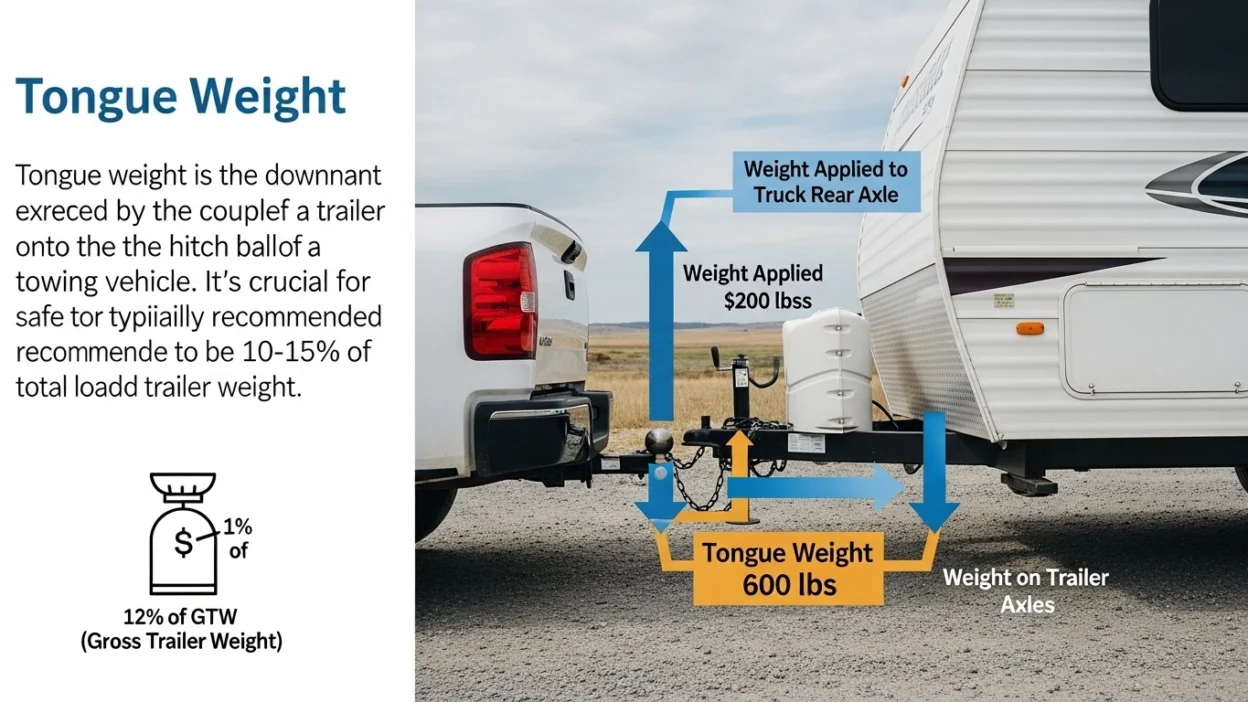
Tongue weight is the downward force that the trailer’s hitch exerts on the towing vehicle, and it plays a major role in vehicle stability, handling, and safety.
Too little tongue weight can cause the trailer to sway dangerously, while too much can overload your rear suspension, affect steering, and reduce braking efficiency.
Understanding tongue weight is essential for anyone who wants a smooth, safe towing experience. In this guide, we’ll break down exactly what tongue weight is, how to measure it, recommended percentages, and tips to adjust it for safe towing.
If you’re a first-time trailer owner or a seasoned driver, knowing your tongue weight can save you from accidents, damage, and costly repairs on the road.
Quick Answer What is Tongue Weight?
Tongue weight is the downward force that a trailer exerts on the hitch of the towing vehicle. Think of it as the “pressure” the trailer puts on your car or truck where it connects. For example, if you have a 2,000-pound trailer and the tongue weight is 10%, that means 200 pounds are pressing down on the hitch ball. This force might seem small compared to the total trailer weight, but it has a significant impact on driving stability and safety.
Proper tongue weight helps maintain control of both the trailer and the towing vehicle. Too little tongue weight—often below 10% of the trailer’s total weight—can cause trailer sway, making it difficult to steer and increasing the risk of accidents. Too much tongue weight—over 15%—can overload the rear axle, reduce front tire traction, and affect braking performance.
Tongue weight is not the same as the total trailer weight. While trailer weight refers to how heavy the trailer is overall, tongue weight focuses on the portion that presses down on the hitch. It’s also different from payload, which is the weight your vehicle can carry including passengers, cargo, and tongue weight combined.
In short, knowing your trailer’s tongue weight and keeping it within the recommended range is essential for safe, stable, and efficient towing. It ensures smoother handling, prevents sway, and protects both your vehicle and trailer.
The Importance of Tongue Weight
Tongue weight might seem like a small detail, but it plays a crucial role in towing safety and vehicle performance. Proper tongue weight ensures that the trailer remains stable behind the towing vehicle, preventing dangerous swaying or fishtailing on the road. When the tongue weight is too light, even small side winds or sudden lane changes can cause the trailer to wobble, making it difficult to control and increasing the risk of accidents.
On the other hand, excessive tongue weight can overload the rear axle of your vehicle. This extra pressure pushes down on the rear suspension, reducing traction on the front wheels. Reduced front-wheel traction affects steering, braking, and overall handling, which can be especially risky in wet or slippery conditions. Over time, carrying too much tongue weight can also lead to premature wear on suspension components, tires, and the hitch itself.
Understanding tongue weight is also important for distributing cargo safely. Placing heavier items in the correct position over the trailer axles and keeping lighter items at the front or rear helps maintain proper tongue weight. This balance not only improves stability but also enhances braking efficiency and fuel economy.
In short, tongue weight directly affects both safety and comfort while towing. By measuring and maintaining the correct tongue weight, drivers can tow with confidence, reduce stress on their vehicle, and ensure a smoother, more controlled ride for themselves and others on the road.
How to Measure Tongue Weight
Measuring tongue weight is essential for safe towing, but many people are unsure how to do it accurately. There are several methods, ranging from simple DIY solutions to professional tools. The most accurate method is using a commercial tongue weight scale, which is specifically designed to measure the downward force on the hitch. These scales are easy to use: place the scale under the trailer coupler, lower the coupler onto it, and read the weight.
If you don’t have a commercial scale, a DIY method using a bathroom scale and a sturdy plank works for lighter trailers. Place the scale on a flat surface, set one end of the plank on the scale, and place the trailer tongue on the other end. The scale will show the force exerted by the tongue. Make sure to adjust for the plank’s leverage to get an accurate reading.
Another way to estimate tongue weight is by checking vehicle and trailer specifications. Manufacturers often provide recommended tongue weight percentages, usually between 10–15% of the total trailer weight. For example, a 3,000-pound trailer would have a recommended tongue weight of 300–450 pounds.
Tips for accurate measurement:
- Always measure with the trailer loaded as it would be on the road, since cargo affects tongue weight.
- Measure on level ground to avoid inaccurate readings.
- Recheck after rearranging cargo to ensure proper balance.
By measuring tongue weight correctly, drivers can prevent trailer sway, avoid overloading their vehicle, and enjoy a safer towing experience.
Recommended Tongue Weight Percentages
Knowing the proper tongue weight for your trailer is crucial for safe and stable towing. As a general rule, tongue weight should be 10–15% of the total trailer weight. This means that if your trailer weighs 2,000 pounds, the tongue weight should fall between 200 and 300 pounds. Staying within this range ensures the trailer remains stable, reduces sway, and allows your towing vehicle to handle safely.
Different types of trailers may require slightly different tongue weight percentages. Small utility trailers or lightweight cargo trailers often perform well at the lower end of the range, around 10%. Meanwhile, larger travel trailers or RVs benefit from tongue weights closer to 12–15% to prevent swaying and improve stability. Exceeding the recommended percentage can overload the rear axle, while having too little tongue weight increases the risk of trailer instability.
It’s important to note that the weight of cargo inside the trailer affects tongue weight. Loading heavy items toward the front or rear can shift the balance, potentially putting the tongue weight outside the safe range. Distributing weight evenly across the trailer and placing the heaviest items over the trailer axles will help maintain proper tongue weight.
Following the recommended percentages not only ensures safety but also improves braking performance, steering, and fuel efficiency. Checking and adjusting tongue weight before every trip is a simple but effective way to prevent accidents and keep both your vehicle and trailer in optimal condition.
Consequences of Incorrect Tongue Weight
Incorrect tongue weight can create serious safety hazards and cause damage to both the trailer and the towing vehicle. When the tongue weight is too light, usually below 10% of the trailer’s total weight, the trailer can sway or fishtail while driving. Even small steering corrections or side winds can magnify this movement, making it difficult to control the vehicle and increasing the risk of accidents.
On the other hand, too much tongue weight, over 15% of the trailer’s total weight, can overload the rear axle of the towing vehicle. This added pressure pushes down on the rear suspension, reducing traction on the front tires. Reduced front-wheel traction negatively impacts steering and braking, which can be especially dangerous during emergency maneuvers or on slippery roads. Excessive tongue weight also increases wear on tires, brakes, and suspension components, potentially leading to costly repairs over time.
Incorrect tongue weight can also affect fuel efficiency. A heavy tongue weight shifts more load to the rear, increasing rolling resistance and requiring more energy to move the vehicle. Additionally, improper weight distribution can make trailers harder to back up or maneuver in tight spaces, creating challenges for parking or storage.
In short, maintaining the correct tongue weight is critical for stability, control, and vehicle longevity. Regularly checking and adjusting the tongue weight ensures safer towing, smoother handling, and protection against unnecessary wear and tear on your vehicle and trailer.
How to Adjust Tongue Weight
Properly adjusting tongue weight is essential for safe towing and smooth handling. One of the simplest ways to adjust tongue weight is by rearranging cargo inside the trailer. Heavy items should be positioned over or slightly in front of the trailer axles, as this helps maintain balance and keeps tongue weight within the recommended 10–15% range. Avoid placing all heavy items at the very front or back, as this can make the trailer unstable or overload the hitch. Lighter items can be placed at the rear or evenly distributed side-to-side to maintain stability.
Another effective method is using a weight distribution hitch. These hitches transfer some of the tongue weight from the rear axle to the front axle of the towing vehicle. They are especially useful for larger travel trailers or RVs, where heavy tongue weight can negatively impact steering and braking. Weight distribution hitches also improve overall trailer control, reduce sway, and minimize strain on the vehicle’s suspension.
Regularly checking tongue weight with a scale is important whenever cargo is added or rearranged. Small adjustments—like moving a few boxes or adjusting the placement of a spare tire—can make a significant difference in handling.
In addition, always make sure the trailer is level when connected to the towing vehicle, as an uneven trailer can shift weight and affect performance. By carefully managing cargo placement, using proper hitches, and regularly measuring tongue weight, you can tow safely, protect your vehicle, and enjoy a smoother driving experience.
Tongue Weight for Different Vehicles
Tongue weight requirements vary depending on the type of towing vehicle and the trailer being used. Small cars and SUVs generally have lower maximum tongue weight limits, usually between 100–200 pounds. These vehicles are best suited for lightweight trailers, such as small utility trailers or compact campers. Overloading the hitch on smaller vehicles can reduce steering control, affect braking, and increase the risk of accidents.
Pickup trucks and full-size SUVs typically handle heavier trailers and higher tongue weights, often ranging from 500 to 1,000 pounds or more, depending on the vehicle model. Even with trucks, it’s important to stay within the manufacturer’s recommended tongue weight limit to prevent suspension wear and maintain safe handling. Vehicle manuals often provide maximum tongue weight specifications for both standard hitches and weight distribution hitches.
When towing larger trailers or RVs, a weight distribution hitch is often necessary to manage higher tongue weights safely. These hitches help redistribute the load between the front and rear axles, improving steering, braking, and overall control. Properly adjusted, they allow even heavy trailers to be towed safely without overloading the vehicle.
Regardless of vehicle type, the key is to measure tongue weight with the trailer fully loaded and make adjustments as needed. Always check manufacturer guidelines for your vehicle and trailer, and ensure the tongue weight remains within the recommended percentage. Following these guidelines ensures safer towing, reduces wear on your vehicle, and provides a smoother, more stable ride on the road.
Tips for Safe Towing with Proper Tongue Weight
Towing safely starts with managing tongue weight correctly. Here are some practical tips to help ensure a smooth and controlled ride:
1. Measure Before Every Trip:
Always check tongue weight before hitting the road. Trailers can shift weight as cargo settles, so rechecking ensures stability. Use a tongue weight scale or a DIY method with a bathroom scale and plank for accurate measurement.
2. Balance Your Load:
Place heavy items over or slightly in front of the trailer axles. Lighter items should go toward the rear and be evenly distributed side-to-side. Proper distribution keeps tongue weight within the recommended 10–15% range and reduces sway.
3. Use a Weight Distribution Hitch for Heavy Trailers:
For larger trailers or RVs, these hitches help transfer some of the tongue weight to the front axle, improving steering, braking, and overall stability.
4. Keep the Trailer Level:
An uneven trailer can shift tongue weight and cause instability. Ensure the trailer sits level when connected to the towing vehicle, especially after loading cargo.
5. Avoid Overloading:
Exceeding the vehicle’s tongue weight limit can strain the suspension, reduce braking efficiency, and damage tires. Check the towing vehicle’s manual for maximum tongue weight recommendations.
6. Drive Cautiously:
Even with proper tongue weight, sudden maneuvers or high speeds can cause sway. Maintain safe speeds and allow extra stopping distance when towing.
FAQs:
1. What happens if tongue weight is too low or too high?
If tongue weight is too low (below 10% of trailer weight), the trailer can sway or fishtail, making steering difficult and increasing accident risk. Too high (above 15%) can overload the rear axle, reduce front-wheel traction, and negatively affect braking and handling.
2. How often should I check tongue weight?
Tongue weight should be checked every time the trailer is loaded, especially after adding cargo. Changes in weight distribution can alter tongue weight, so regular measurement ensures stability and safety.
3. Can tongue weight affect trailer sway?
Yes. Insufficient tongue weight is the most common cause of trailer sway. Maintaining the recommended 10–15% range helps keep the trailer stable, especially at higher speeds or in windy conditions.
4. How do I measure tongue weight?
Tongue weight can be measured using a commercial tongue weight scale, a DIY plank and bathroom scale, or estimated from manufacturer guidelines. For the most accurate results, measure when the trailer is fully loaded and on level ground.
5. What is the difference between trailer weight, tongue weight, and GVWR?
- Trailer weight is the total weight of the trailer, including cargo.
- Tongue weight is the portion of that weight pressing down on the hitch.
- GVWR (Gross Vehicle Weight Rating) is the maximum weight your trailer or vehicle can safely carry.
6. Can I adjust tongue weight without moving cargo?
Yes, using a weight distribution hitch can redistribute the load, reducing pressure on the rear axle while improving towing stability.
Conclusion
Tongue weight may seem like a small detail, but it is one of the most important factors for safe and stable towing.
Maintaining the correct tongue weight, typically 10–15% of your trailer’s total weight, ensures better control, reduces sway, and protects your vehicle’s suspension and tires.
Measuring tongue weight accurately, whether with a commercial scale, a DIY method, or by following manufacturer guidelines, allows you to adjust cargo placement or use a weight distribution hitch effectively.
Proper load distribution, keeping the trailer level, and staying within your vehicle’s limits all contribute to a smoother, safer towing experience.
By paying attention to tongue weight and making adjustments as needed, you can tow with confidence, avoid accidents, and extend the life of both your trailer and towing vehicle. Remember, a small adjustment in tongue weight can make a big difference on the road.

Rafael Domínguez Gamas (born February 14, 1883 in Cárdenas, Tabasco; died January 23, 1959 in Veracruz) was a prominent Mexican lawyer, educator, journalist, writer, and academic. He studied law at the Instituto Juárez and also worked as a professor there. Early in his career he directed schools in various towns in Tabasco and contributed frequently to publications such as Alba, El Renacimiento, and El Eco de Tabasco. In 1914 he moved to Veracruz, where he worked with the journal El Dictamen. He was later elected a corresponding member of the Academia Mexicana de la Lengua for his contributions to Mexican literature and language studies. Domínguez authored numerous books and essays including Azul como tus ojos (1925) and Diccionario general de gentilicios (1948).