

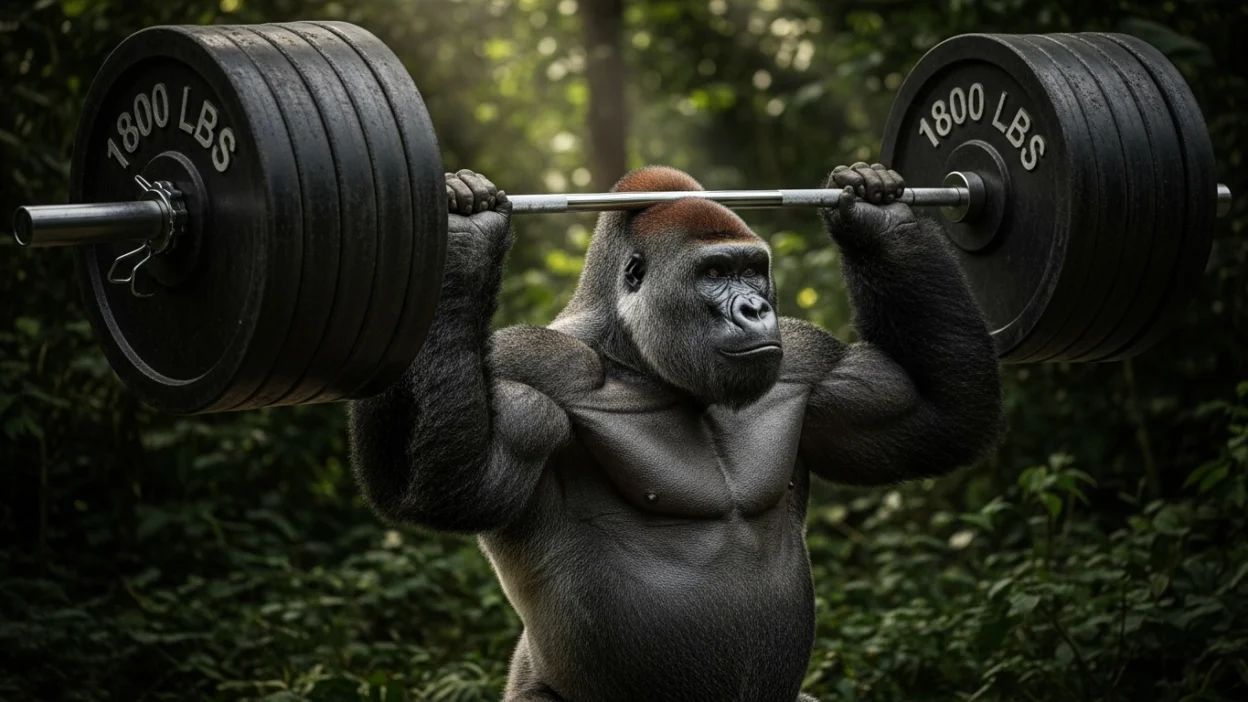
Gorillas are among the strongest animals on the planet, and their incredible strength has fascinated humans for decades.
Many people wonder, “How much weight can a gorilla lift?” a question that sparks curiosity not only among wildlife enthusiasts but also gym lovers and science fans.
With muscular arms, dense bones, and powerful shoulders, gorillas can perform feats that far exceed the average human’s capabilities.
Silverback gorillas, the dominant males, are especially known for their exceptional lifting power, capable of moving heavy branches, rocks, and other objects in their natural habitat.
But despite popular myths, their strength has limits, and scientists have spent years studying exactly how much these primates can lift and why.
In this article, we’ll explore the science behind gorilla strength, examine the factors that affect their lifting capacity, compare them to humans, and uncover amazing stories that showcase just how powerful these incredible creatures really are.
Quick Answer How Much Weight Can a Gorilla Lift?
So, how much weight can a gorilla actually lift? While estimates vary, most scientists agree that an adult male silverback gorilla can lift between 1,800 and 2,000 pounds (820–900 kilograms) under optimal conditions. This is 4–10 times the strength of an average human, depending on the type of lift. Gorillas are not trained weightlifters, of course—their strength comes naturally from their muscular anatomy, long arms, and daily activities in the wild, such as climbing, dragging, and manipulating heavy objects.
It’s important to understand that gorilla strength isn’t just about lifting weights in a gym-like sense. Gorillas excel in pulling, pushing, and breaking objects. For example, a silverback can easily bend metal bars or break bamboo trunks while foraging or defending its territory. Female gorillas, while smaller and less muscular than males, can still lift several hundred pounds, which is far beyond most humans’ capabilities.
While popular myths sometimes claim gorillas can lift “10,000 pounds or more,” there is no scientific evidence to support these extremes. Verified studies show that their true lifting capacity is extraordinary yet realistic, and it allows them to survive and thrive in the wild.
Anatomy of a Gorilla Why They Are So Strong
The extraordinary strength of gorillas is rooted in their unique anatomy. Unlike humans, gorillas have densely packed muscles, especially in their arms, shoulders, and chest, which allow them to generate massive force with each movement. Their long, powerful arms provide significant leverage, making tasks like lifting, pulling, and climbing easier and more efficient.
Bone structure also plays a crucial role. Gorillas have thick, robust bones, particularly in the arms and legs, which support their heavy muscles and reduce the risk of injury during strenuous activity. Their tendons and ligaments are equally strong, acting like natural shock absorbers and allowing them to handle extreme loads without damage.
Another key factor is their grip strength. Gorillas can grasp, hold, and manipulate objects with incredible precision, using their opposable thumbs and fingers. This gives them the ability to lift or pull objects many times heavier than their own body weight.
Even their posture contributes to their power. Gorillas walk on their knuckles, which shifts weight to their arms and enhances upper-body strength. Meanwhile, their large chest and back muscles provide additional lifting power, making them nature’s ultimate lifters.
In short, gorilla anatomy is a perfect combination of muscular power, skeletal support, and mechanical advantage. These features make it clear why gorillas can lift, pull, and move objects that would be impossible for most humans.
Types of Gorillas and Their Lifting Power
Not all gorillas have the same strength—lifting power can vary depending on the species, age, and sex of the gorilla. There are two main species of gorillas: Western Lowland Gorillas and Eastern Gorillas, which include the mountain gorilla. Both species have remarkable strength, but slight differences in size and muscle mass affect how much they can lift.
Silverback males are the strongest members of any gorilla group. Weighing between 300 and 450 pounds (140–200 kilograms), these dominant males have fully developed muscles that allow them to lift between 1,800 and 2,000 pounds (820–900 kilograms). Their strength is crucial for protecting their group, moving large objects, and climbing trees or rough terrain.
Female gorillas are smaller and generally lift less, typically around 500 to 600 pounds (225–275 kilograms). Even though they are not as strong as silverbacks, their lifting ability is still far beyond the average human’s capacity.
Younger male gorillas gradually develop their strength as they grow. By the time they reach full maturity around 12 years old, their muscles and bones are strong enough to perform feats similar to those of silverbacks.
Wild gorillas often display their power by dragging heavy branches, moving rocks, or breaking bamboo trunks, which shows how their lifting ability is not just theoretical—it’s used daily for survival.
Scientific Studies on Gorilla Strength
Researchers and primatologists have long been fascinated by gorilla strength, but studying it scientifically can be challenging because gorillas cannot be asked to perform controlled “weightlifting” experiments. Instead, scientists rely on observations in the wild, controlled studies in zoos, and anatomical analysis to estimate their capabilities.
Field studies have shown that adult male gorillas, especially silverbacks, regularly move or lift objects that weigh hundreds of pounds. They can bend metal bars, break tree branches, and drag large logs, demonstrating both raw strength and endurance. Such observations provide practical evidence of their immense power.
Controlled experiments in captivity focus on muscle structure, bite force, and limb strength. For example, primatologists have used motion sensors and force-measuring devices to gauge pulling and gripping strength. These studies confirm that gorillas can exert 4–10 times the force of an average human, especially with their upper body.
Despite these findings, many popular claims about gorilla strength—like lifting 10,000 pounds—are exaggerated. Scientific research provides realistic and verifiable data, showing that their lifting capacity, while extraordinary, is not limitless.
In addition, studies show that strength varies by age, sex, and species. Silverbacks are the peak of gorilla power, whereas females and younger males are naturally less strong. Diet, health, and environment also play significant roles.
Factors Affecting How Much a Gorilla Can Lift
While gorillas are naturally strong, several factors influence exactly how much weight they can lift. Age is one of the most important factors. Young gorillas gradually build muscle as they grow, reaching peak strength around 12 to 15 years old, when males become fully mature silverbacks. Older gorillas may maintain impressive strength but often lose some lifting power due to natural aging.
Sex also plays a major role. Male gorillas, especially silverbacks, have significantly more muscle mass and can lift heavier objects than females. Female gorillas are strong in their own right but typically lift around half of what a silverback can manage.
Diet and nutrition are crucial. Gorillas consume a diet rich in fruits, leaves, and stems, which provides protein and other nutrients that support muscle development. Well-fed gorillas in captivity may develop slightly more bulk than wild gorillas, but their strength in natural movements remains consistent.
The environment matters too. Wild gorillas perform physically demanding tasks daily, like climbing trees, moving logs, or defending territory, which naturally maintains their strength. Captive gorillas may not lift as much during normal activity, though enrichment exercises can help preserve muscle power.
Health and injury history also affect lifting ability. Gorillas with injuries or diseases may have limited strength temporarily.
Overall, gorilla strength is not uniform; it depends on age, sex, diet, environment, and health. These factors explain why lifting capacity can vary even within the same species.
Gorilla Strength vs. Human Strength
Gorillas are often described as “super strong,” but how do they actually compare to humans? On average, an adult male gorilla is 4 to 10 times stronger than the average human, depending on the type of movement and muscle group involved. Their upper-body strength is especially remarkable, allowing them to lift, pull, or drag heavy objects far beyond what even elite human weightlifters can manage relative to body size.
For context, a trained human weightlifter can lift around 400–600 pounds (180–270 kilograms) in exercises like the deadlift or bench press. In comparison, a silverback gorilla can lift 1,800–2,000 pounds (820–900 kilograms) or more under natural conditions. This immense strength comes not from practice in a gym but from evolutionary adaptations: dense muscles, powerful tendons, long arms, and strong bones.
Gorillas also excel at gripping, pushing, and pulling. While humans can lift with precision, gorillas use their hands and arms to move large objects effortlessly, sometimes even exceeding their own body weight. Their strength is functional, designed for climbing, defending territory, and foraging, rather than structured lifting like humans do.
It’s important to note that female gorillas, though smaller, are still significantly stronger than humans. Even a smaller adult female can lift hundreds of pounds—far beyond what most people can manage.
Understanding these differences highlights just how impressive gorilla strength is and why humans, despite technology and training, cannot match nature’s design.
Amazing Stories and Anecdotes of Gorilla Strength
Gorilla strength is not just a scientific estimate—it’s witnessed in countless real-life anecdotes. Zookeepers and wildlife experts often report observing gorillas performing feats that leave humans astonished. For instance, silverbacks in captivity have been seen lifting and moving logs weighing several hundred pounds with ease, often to rearrange their enclosures or reach food.
In the wild, gorillas regularly display their power. Observations show silverbacks breaking thick bamboo stalks, dragging heavy branches, and even moving large rocks to build nests or protect their group. These actions demonstrate functional strength—strength designed for survival rather than spectacle.
One famous story comes from a wildlife documentary where a silverback lifted a massive branch to shield younger gorillas from potential danger. Another example involves zookeepers noticing gorillas effortlessly bending metal bars during routine enrichment exercises. Such accounts emphasize that gorilla strength is both practical and extraordinary, not just a theoretical measure from research studies.
It’s important to note that while gorilla strength is incredible, it is often exaggerated in popular media. Myths claiming they can lift 10,000 pounds or more are unverified. However, documented feats—like moving objects several times their body weight—highlight why these primates are considered some of the strongest animals on Earth.
Training Gorillas: Is It Possible?
Many people wonder if gorillas can be trained to increase their strength like humans do in gyms. The answer is not in the traditional sense. Gorillas are naturally strong, and their muscles are adapted for survival activities such as climbing, foraging, and defending their group. Unlike humans, they do not follow structured weightlifting routines, so “training” them to lift heavier weights is neither practical nor necessary.
In captivity, however, zookeepers use enrichment exercises to keep gorillas active and healthy. These activities may involve climbing structures, moving weighted objects, or solving physical puzzles that encourage strength use. While this doesn’t dramatically increase their natural lifting capacity, it helps maintain muscle tone, prevent obesity, and stimulate mental engagement.
Some controlled studies have also observed that gorillas can learn tasks involving pushing, pulling, or lifting objects to receive rewards. These activities showcase their natural power while providing mental stimulation, but they do not significantly enhance maximum strength beyond what evolution has already equipped them with.
Ethical considerations are critical. Any attempt to “train” gorillas beyond enrichment could stress the animal or cause harm. Their strength is meant for daily survival in the wild, not human entertainment or experimentation.
In short, gorillas cannot be trained like human weightlifters. Instead, they maintain their remarkable power through natural behaviors, diet, and environment.
Common Myths and Misconceptions About Gorilla Strength
Gorilla strength has fascinated humans for generations, but it is also the source of many myths and misconceptions. One of the most common myths is that gorillas can lift 10,000 pounds or more. While they are incredibly strong—able to lift and move objects far heavier than humans—their true lifting capacity is much lower, with silverbacks typically lifting around 1,800–2,000 pounds (820–900 kilograms).
Another misconception is that gorillas are naturally aggressive due to their strength. In reality, gorillas are generally gentle and avoid conflict. They display aggression only when threatened or defending their group, and even then, their strength is used primarily as a deterrent rather than for unnecessary violence.
Some people also assume that all gorillas have the same strength. Strength varies significantly based on age, sex, species, and health. Male silverbacks are the strongest, while females and younger gorillas are naturally less powerful, though still far stronger than most humans.
Media and movies often exaggerate gorilla strength for dramatic effect, showing them lifting impossibly heavy objects or performing superhero-like feats. These portrayals, while entertaining, do not reflect scientific observations.
Understanding these myths is important for appreciating gorillas as they truly are: powerful yet intelligent animals whose strength is functional and natural, not exaggerated for human imagination.
FAQs:
1. How much stronger is a gorilla than a human?
On average, adult male gorillas are 4–10 times stronger than humans. Their strength is concentrated in their upper body, especially arms and shoulders, enabling them to lift and move heavy objects effortlessly.
2. Can gorillas lift more than their body weight?
Yes. Silverback gorillas can lift, pull, or drag objects well over their own body weight, often reaching 1,800–2,000 pounds in extreme cases. Even female gorillas can lift several hundred pounds.
3. What is the strongest gorilla ever recorded?
While there is no official record, silverbacks in the wild and captivity have consistently demonstrated the ability to move extremely heavy logs, rocks, and branches. These practical feats showcase their immense strength.
4. Do female gorillas lift less than males?
Yes. Female gorillas are smaller and less muscular than males, but their lifting capacity still far exceeds that of an average human.
5. Why are silverbacks the strongest gorillas?
Silverbacks are fully mature adult males with peak muscle mass and bone density. Their strength is essential for protecting the group, climbing, and performing survival tasks.
Conclusion
Gorillas are truly remarkable animals, and their strength is one of nature’s most impressive feats. Adult male silverbacks can lift, pull, or drag objects weighing 1,800–2,000 pounds (820–900 kilograms), making them 4–10 times stronger than the average human.
This power comes from a combination of dense muscles, strong bones, long arms, and natural leverage, all designed for survival in the wild. Female gorillas and younger males are also extremely strong, capable of lifting hundreds of pounds with ease.
Scientific studies, real-life observations, and anecdotes confirm that gorilla strength is extraordinary yet functional, allowing them to climb, forage, build nests, and protect their group.
While myths sometimes exaggerate their capabilities, understanding their anatomy, species differences, and natural behavior gives us a clear picture of their true power.

Daniel Johansson is an acclaimed Swedish operatic tenor, celebrated internationally for his powerful voice, dramatic presence, and versatile repertoire spanning from Puccini to Wagner. Born in Småland, Sweden, he trained at the University College of Opera in Stockholm, where he laid the foundation for a distinguished career in classical music and opera performance.