
Losing weight can feel like a constant struggle, even when you’re hitting the gym regularly.
The truth is, not all exercise burns fat equally. One of the most effective ways to maximize weight loss is by exercising within your target heart rate (THR) zone.
Your heart rate isn’t just a number—it’s a powerful guide that tells you exactly how hard your body is working and how efficiently it’s burning calories.
By understanding your target heart rate for weight loss, you can ensure that every workout is optimized for fat burning, cardiovascular health, and overall fitness.
Exercising too lightly may not burn enough calories, while pushing too hard can lead to fatigue or even injury.
In this guide, we’ll break down everything you need to know—from calculating your target heart rate and ideal exercise zones to the best workouts that keep your heart in the fat-burning sweet spot.
What is Target Heart Rate?
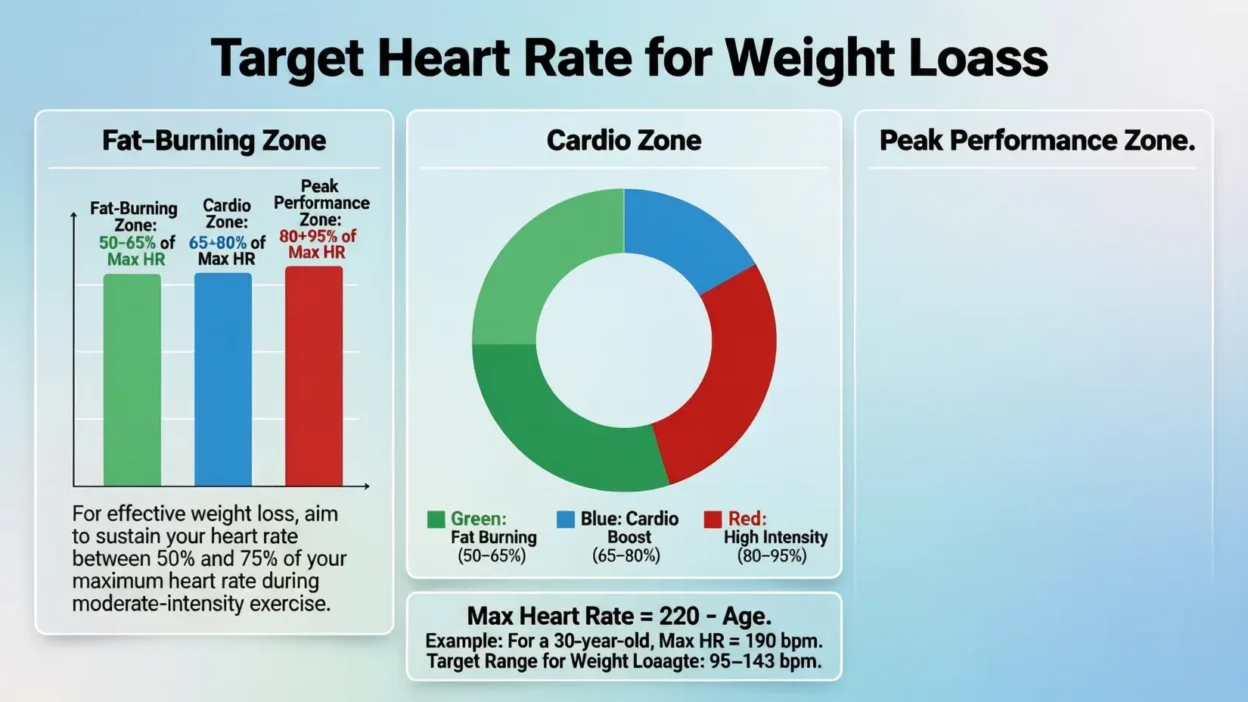
Understanding your target heart rate (THR) is the first step toward effective weight loss. Your target heart rate is the ideal range at which your heart should beat during exercise to maximize fat burning and improve cardiovascular health. It’s usually expressed as a percentage of your maximum heart rate, which is roughly calculated using the formula: 220 minus your age.
For example, if you are 30 years old, your estimated maximum heart rate is 190 beats per minute (bpm). To burn fat effectively, you would aim for 50–70% of that, which is approximately 95–133 bpm. This range is commonly referred to as the fat-burning zone, where your body primarily uses fat as fuel.
Target heart rate is different from your resting heart rate, which is your heart rate when you’re at complete rest, and your maximum heart rate, which is the highest rate your heart can safely reach. Exercising too lightly, below your target zone, may not burn enough calories, while pushing above your zone for too long can lead to fatigue or even injury.
By knowing your target heart rate, you can monitor your intensity, track your progress, and make sure your workouts are efficient. Fitness trackers, heart rate monitors, and even smartphone apps can help you stay in the right zone, making your weight loss journey safer, more effective, and measurable.
Why Target Heart Rate Matters for Weight Loss
Exercising without monitoring your heart rate can make weight loss less efficient. Your target heart rate (THR) is important because it ensures your body is working at the right intensity to burn fat effectively. When you stay within your target heart rate zone, your body primarily uses fat as fuel rather than carbohydrates, helping you lose weight more efficiently.
Working out below your target heart rate might feel comfortable, but it often burns fewer calories and fat. On the other hand, exercising above your target zone can push your body into a high-intensity state, burning more calories temporarily but also causing fatigue and reducing the time you can spend exercising. This means less overall fat loss over time.
Scientific studies show that staying in the fat-burning zone for at least 30–45 minutes several times a week can significantly improve weight loss and cardiovascular health. Additionally, tracking your heart rate helps you progress safely, avoid overtraining, and maintain consistent results.
Your target heart rate also provides a measurable goal. Instead of guessing whether your workout is effective, you can rely on real numbers to adjust your intensity. This makes it easier to create a structured exercise plan that’s personalized for your age, fitness level, and weight loss goals.
How to Calculate Your Target Heart Rate
Calculating your target heart rate (THR) is easier than many people think, and it’s a crucial step for effective weight loss. The most common method starts with determining your maximum heart rate (MHR), which is roughly calculated using the formula: 220 minus your age. For example, if you are 40 years old, your MHR would be 180 beats per minute (bpm).
Once you know your maximum heart rate, you can calculate your target heart rate zone. For fat burning and weight loss, aim for 50–70% of your maximum heart rate. Using the example above, 50% of 180 bpm is 90 bpm, and 70% is 126 bpm. This means during moderate-intensity workouts, your heart rate should stay between 90 and 126 bpm to burn fat efficiently.
For higher-intensity workouts, such as cardio or interval training, you can aim for 70–85% of your maximum heart rate, which improves cardiovascular fitness and burns more calories. However, beginners or those with medical conditions should start in the lower range and gradually increase intensity.
You don’t need to guess your heart rate. Tools like fitness trackers, heart rate monitors, and smartphone apps can help you stay within your target zone. Additionally, using the Rate of Perceived Exertion (RPE) scale—rating how hard you feel you’re working from 1 to 10—can help you estimate intensity if you don’t have a monitor.
Best Exercises to Reach Your Target Heart Rate
To effectively lose weight, it’s important to choose exercises that keep your heart within your target heart rate (THR) zone. The right exercises help you burn fat efficiently, improve cardiovascular health, and maintain consistency in your workouts.
Cardio exercises are the most effective for reaching your target heart rate. Activities like running, jogging, brisk walking, cycling, and swimming naturally elevate your heart rate into the fat-burning zone. For beginners, brisk walking or light jogging is a safe way to start, while more advanced exercisers can push their intensity with running, cycling sprints, or swimming laps.
High-Intensity Interval Training (HIIT) is another excellent option. Short bursts of intense activity followed by recovery periods help your heart rate rise and fall, which can maximize calorie burn and fat loss in a shorter amount of time. Exercises like jump squats, burpees, or sprint intervals can be incorporated to target your THR efficiently.
Strength training also supports fat loss by building lean muscle, which increases metabolism and helps you burn more calories even at rest. Combining strength training with cardio ensures you hit your target heart rate while also improving muscle tone and endurance.
To monitor your intensity, use heart rate monitors, fitness trackers, or smartphone apps, checking that your heart rate stays within the fat-burning zone for at least 30 minutes per session. By choosing the right exercises and tracking your heart rate, you can ensure that your workouts are both safe and effective for reaching your weight loss goals.
Tips for Safely Maintaining Your Target Heart Rate
Maintaining your target heart rate (THR) safely is essential for effective weight loss and overall health. Exercising in the right zone maximizes fat burning, but pushing too hard or not monitoring your intensity can lead to fatigue, injury, or even cardiovascular stress.
Start with a warm-up:
Begin each session with 5–10 minutes of light cardio, such as walking, jogging in place, or dynamic stretches. This gradually raises your heart rate and prepares your muscles for more intense activity. Similarly, finish with a cool-down to lower your heart rate gradually, preventing dizziness and promoting recovery.
Stay hydrated:
Water is critical for maintaining heart efficiency. Dehydration can elevate your heart rate and make exercise feel harder than it should. Drink water before, during, and after your workout.
Listen to your body:
While heart rate monitors are helpful, always pay attention to how you feel. Signs like dizziness, shortness of breath, or chest discomfort mean it’s time to slow down or stop.
Use monitoring tools wisely:
Fitness trackers, heart rate monitors, and smartphone apps help you stay in your target zone. For beginners, using the Rate of Perceived Exertion (RPE) scale, rating your effort from 1 to 10, can be an additional guide.
Avoid overtraining:
Give your body at least one day of rest between intense workouts. Consistency is more important than intensity for long-term fat loss.
Common Mistakes to Avoid
Even with the right knowledge, many people make mistakes that reduce the effectiveness of their workouts and slow down weight loss. Understanding these common mistakes can help you stay on track and get the most out of your exercise routine.
Skipping heart rate monitoring is a frequent error. Without tracking your heart rate, you may exercise too lightly, burning fewer calories, or too intensely, risking fatigue and injury. Always check your heart rate to ensure you stay within your target heart rate zone.
Overestimating effort is another mistake. Many people assume they are working hard enough based on how they feel, but perceived effort can be misleading. Using a heart rate monitor or Rate of Perceived Exertion (RPE) scale helps ensure you are exercising at the right intensity for fat loss.
Focusing solely on cardio while neglecting strength training is also counterproductive. Building lean muscle boosts metabolism, helping your body burn more calories at rest. A combination of cardio and strength training is most effective for long-term fat loss.
Ignoring age, fitness level, or medical conditions can also reduce results or be dangerous. Your target heart rate depends on these factors, so adjust intensity accordingly and consult a healthcare provider if needed.
Finally, relying on inaccurate devices or not regularly recalculating your target heart rate as your fitness improves can lead to ineffective workouts. Make adjustments as your endurance and strength increase.
FAQs
Many people have questions about using target heart rate (THR) for weight loss. Here are some common questions and answers to help you understand how to exercise safely and effectively.
1. How long should I stay in my target heart rate zone?
For optimal fat burning, aim to stay in your fat-burning zone for at least 30–45 minutes per session, three to five times per week. Beginners can start with shorter sessions and gradually increase duration.
2. Can I lose weight without monitoring my heart rate?
Yes, but monitoring your heart rate ensures your workouts are efficient. Exercising without tracking may result in spending too much time at low intensity, burning fewer calories, or overexerting yourself, which can increase fatigue and risk of injury.
3. Does strength training affect my target heart rate?
Strength training can raise your heart rate, especially during circuit training or high-intensity sets. While cardio is more effective for continuous fat burning, combining strength training helps build lean muscle, increasing metabolism and supporting long-term weight loss.
4. How does age affect target heart rate?
Your maximum heart rate decreases with age, so your target heart rate zones are lower as you get older. It’s important to adjust your intensity based on your age and fitness level.
5. Is it safe for beginners or older adults?
Yes, as long as workouts are tailored to fitness level and monitored carefully. Starting in the lower range of your target heart rate zone and gradually increasing intensity is safest.
Conclusion
Understanding and using your target heart rate (THR) is one of the most effective ways to achieve consistent weight loss while keeping your workouts safe and efficient.
Rather than guessing if your exercise is effective, monitoring your heart rate provides a measurable and personalized approach.
By staying in your fat-burning zone, you ensure that your body is burning the right fuel—primarily fat—while also improving your cardiovascular health.
Calculating your target heart rate is simple: subtract your age from 220 to estimate your maximum heart rate, then work within 50–70% of that range for moderate-intensity fat burning.
High-intensity workouts can go up to 85% for more advanced fitness goals. Using fitness trackers, heart rate monitors, or smartphone apps makes it easier to stay in the right zone and track your progress over time.
Choosing the right exercises, such as cardio, HIIT, and strength training, helps you reach your target heart rate efficiently.
Combined with proper warm-ups, cool-downs, hydration, and listening to your body, these practices reduce the risk of injury and prevent overtraining.
Avoiding common mistakes, like ignoring heart rate or overestimating effort, ensures every workout contributes to your weight loss goals.
In short, incorporating your target heart rate into your exercise routine allows for smarter, more effective workouts. It’s a reliable tool to maximize fat burning, improve endurance, and see results faster.
Start tracking your heart rate today, stay consistent, and you’ll notice the benefits not only in your weight loss journey but in your overall fitness and well-being.

Margaret Johnson was an American blues and early jazz vocalist and pianist active during the 1920s. She began her recording career in the early part of that decade, performing in vaudeville and jazz ensembles, and is best remembered for her work in blues music.